Decarbonisation software
SBTi & CRREM targets
Set targets aligned with SBTi and CRREM. Build your initiative portfolio from 200+ real-project-tested options. Model scenarios with CAPEX and ROI before committing budget. Turn measurement into a decision.

Active target
-10%
GHG Protocol, ISO 14064, CSRD, GRI & CDP








Intuitive workflow
Identify the hotspots driving your emissions
See which scopes, categories and business units contribute most to your footprint. Broken down by magnitude, not listed alphabetically.
Compare your emission profile against peers in your sector to understand whether your hotspots are structural or addressable.
Focus reduction investment where the data says it has the greatest measurable impact, not where it is most visible.
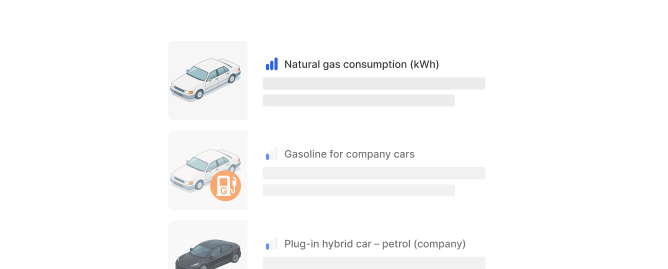
Set reduction targets across your carbon footprint
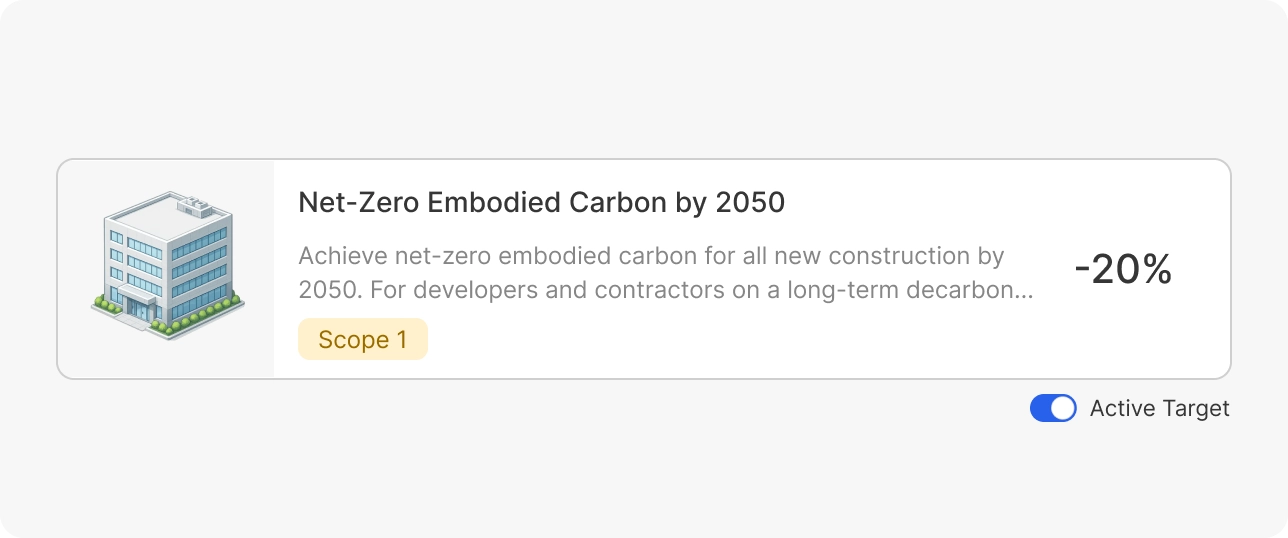
Create reduction targets at the level that matters: company-wide, by scope, category, business unit, asset or emission source.
Define targets using actual footprint data, so each objective is linked to a measurable baseline and relevant performance indicators.
Prioritize the areas where the data shows the greatest material impact, instead of spreading effort evenly across low-impact categories.
Target
Across
Emissions by Month
Turn targets into actionable pathways
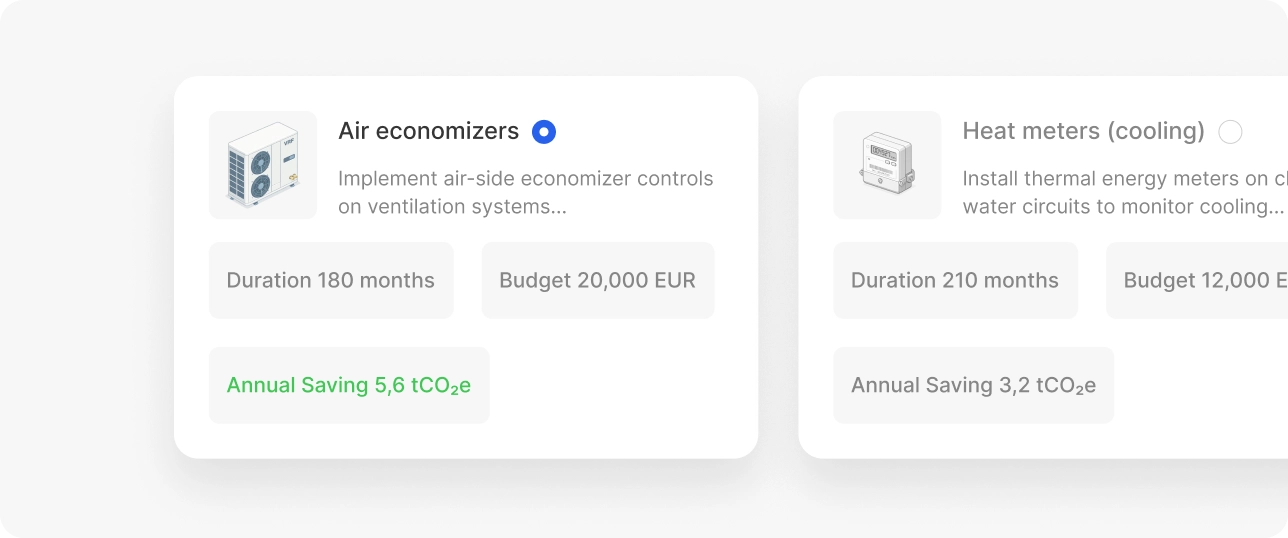
Build initiatives that explain how each reduction target will be achieved, from operational changes to procurement or efficiency measures
Link every action to its emission source, budget, timeline, owner and expected CO₂e savings, so progress can be tracked clearly.
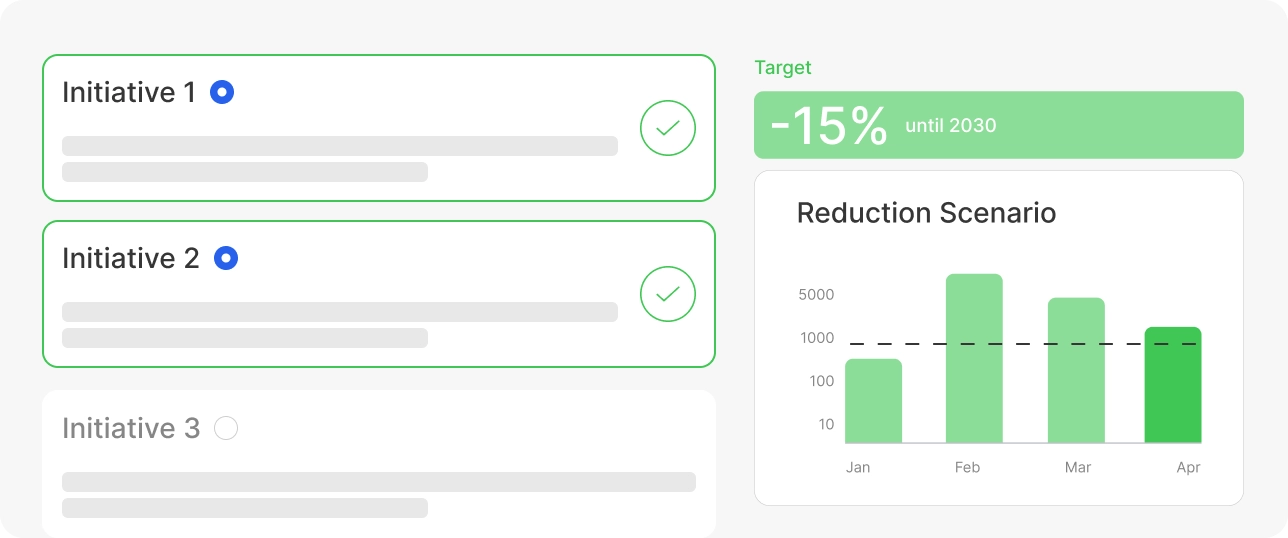
Combine initiatives into scenarios to compare decarbonization pathways and understand the long-term impact of different decisions.

Digital invoicing / paperless office
3 | Purchased goods & servicesBudget 2,000 EUR
Savings 10 tCO2e

Process water recirculation
3 | Capital GoodsBudget 10,000 EUR
Savings 10 tCO2e
Total Savings
Duration 0 months
Budget 0 EUR
Watch your plan play out in real time
Monitor progress against every target across scopes and business units. Updated as new data comes in, not recalculated manually before each review.
Compare planned versus actual reductions period by period, so you know whether your initiatives are performing as modelled or need adjustment.
Adjust initiatives and scenarios as your data, operations or regulatory context change, without rebuilding the plan from scratch.
Emissions by Month
Scope 1
9.5% increase
Scope 3
24% decrease
Five ways to import data
Five ways to get your emission data into CarbonTool. Start with one, add more as your process matures.
Targets
Set absolute or intensity-based reduction targets aligned with SBTi pathways or CRREM trajectories. Build custom targets where framework alignment does not apply. Progress is tracked automatically against your live inventory data by scope, business unit and reporting period. Targets stay connected to reality, not fixed to a baseline model.
Why companies choose CarbonTool

Verified emissions reduction
1,204,312 tCO₂e
Stay compliant
Meet CSRD, VSME, GRI, and CDP requirements on the same data backbone. Structure your data once, report across every framework without duplicate entry.
Cut costs
Starting at €2,000/year with unlimited users. No per-seat fees, no implementation consultants. Where most platforms charge €20,000–50,000+, CarbonTool gives you the same capabilities at a fraction.
Market advantage
Customers, investors, and regulators increasingly require emission data. Companies that measure early build credibility — and avoid the rush when reporting becomes mandatory.
Centralize all data
One platform for all scopes, all business units, all reporting periods. Replace scattered spreadsheets with a single data backbone that feeds your footprint, targets, scenarios, and reports.
Got more questions?
Can't find what you're looking for? Check the FAQs below, or reach out and we'll get back to you within one business day.
A target is the commitment, the reduction you have decided to achieve by a defined date, aligned with SBTi, CRREM or your own framework. A scenario is the modelled pathway to get there, a combination of initiatives with CAPEX estimates and projected reductions. CarbonTool keeps both connected. Your scenario is tested against your target and your actual data is tracked against both.
Yes. The initiative library was built from over 15 years of sustainability project delivery by BuildGreen, the team behind 500+ BREEAM, LEED and EDGE certifications. Each initiative reflects what was actually implemented, what it cost and what it reduced, not a generic benchmark assembled from secondary research. Estimates are a starting point. Your own project data refines them as you implement.
CarbonTool structures the baseline inventory and target trajectories to the format required for SBTi submission, covering Scope 1, 2 and material Scope 3 categories with the correct boundary definitions and reduction percentages. The platform does not submit on your behalf, but it produces the structured data and documentation that the SBTi validation process requires, reducing the preparation work significantly.
You select initiatives from the library or create custom ones and assign them to a scenario. CarbonTool calculates the projected cumulative emission reduction, total CAPEX, ROI and payback timeline for the combined portfolio. You can compare multiple scenarios side by side. For example, a faster, higher-cost pathway versus a longer, lower-capital one. Export the comparison for board or investor review.
Gain Sustainability Insights
Measurement without a plan is just reporting.
Build the plan .
A reliable tool to measure carbon footprint, achieve sustainability goals and take actions against climate change.